
How to Talk to a Sommelier: Stating Budgets, Flavors, and Vintages Without the Awkwardness
Redefining the Wine List Encounter at Fine Dining Tables
The leather-bound wine list can make even an assured diner hesitate. Pages of unfamiliar producers, appellations, vintages, and prices create the impression that every bottle requires an examination before it can be ordered. That anxiety is unnecessary. A restaurant wine list is not a test, and the person presenting it is not waiting for a pronunciation mistake or an incomplete understanding of Burgundy.
A modern floor sommelier is a hospitality professional, a guide whose job is to connect the table with a bottle that suits the food, the occasion, the budget, and the people drinking it. The role combines technical knowledge with communication, warmth, and careful listening. Understanding the professional evolution of the sommelier helps diners recognize that the position is rooted in service, not gatekeeping. Treat the consultation as an open conversation, and the result is often a bottle that feels more personal and more exciting than the safest familiar label.
Stating Your Budget Without Speaking Numbers Aloud
Budget is one of the most useful pieces of information a sommelier can receive, yet guests sometimes feel that mentioning it will make the table appear unsophisticated. In practice, a clear price boundary allows the professional to work more intelligently. Restaurant lists can contain wide variations in markup, producer reputation, vintage scarcity, and regional demand. A bottle that costs more is not automatically the better choice, while an unfamiliar appellation may offer remarkable value.
The most discreet method is the point-and-anchor approach. Once the list is open, point to a bottle near the amount you want to spend and say, “We would love to stay around this neighborhood,” or, “Something in this range would be ideal.” The gesture communicates a budget without announcing a number across the table. If the list is digital, point to a comparable selection or use direct but relaxed language: “Could you recommend something around this price that would work with dinner?”
For a more precise conversation, offer a range and add the occasion. “We are looking for a celebratory bottle, but we would like to remain between these two sections,” gives the sommelier room to distinguish between a special producer, an older vintage, and a high-value alternative. If the list is not available before the meal, asking for a private word before ordering can make the exchange even easier. A capable sommelier will not shame a boundary or push only the most expensive labels. Respectful budget-conscious selling is part of professional hospitality.
- Point to a nearby bottle and say, “Something around here would be perfect.”
- Give a range rather than apologizing for a limit.
- Explain whether the bottle is for a toast, a business dinner, or a relaxed meal.
- Ask whether a less famous region or grape offers better value at that price.
It is also reasonable to verify an unusually low listed price before ordering, especially when the bottle appears dramatically out of proportion to neighboring wines. Politely asking the server to confirm the listing avoids an awkward correction later and demonstrates good faith. The goal is not to exploit an obvious clerical mistake, but to establish the price clearly before the bottle is opened.
Translating Cravings Into Plain Flavor Vocabulary
You do not need to name a grape, region, or producer to communicate what you enjoy. The most useful descriptions are often sensory and direct. “Crisp” suggests freshness and lively acidity. “Rounded” or “rich” points toward a fuller texture. “Earthy” may indicate savory, forest-floor, mushroom, or dried-herb notes. “Light red” and “softer tannins” tell the sommelier that a delicate, supple style is preferred over a heavily structured wine.
Familiar reference points are especially helpful. If you regularly order Chablis, Barolo, Sauvignon Blanc, or California Cabernet, mention it as a starting point rather than a demand. A useful script is, “We usually drink Chablis, but we would enjoy something with a similar mineral freshness from another region.” Another is, “We like Cabernet, though we would prefer less oak and softer tannins tonight.” This gives the sommelier a reliable benchmark while leaving space for a more interesting recommendation.
Wine knowledge develops through repeated experience, not through memorizing prestigious labels. An accessible bottle that you revisit can become a personal reference point for acidity, texture, body, and age. That lived familiarity is more valuable than pretending to recognize every name on a rarefied list. When describing preferences, be candid about both likes and dislikes, including sweetness, oak, bubbles, high alcohol, or pronounced acidity. One clear sentence is usually more useful than a paragraph of technical terminology.
| Palate preference | Effective table script |
|---|---|
| Fresh white wine | “We would like something crisp, bright, and not too heavy.” |
| Fuller white wine | “Could you find a rounded white with some texture, but not too much oak?” |
| Light red wine | “A fresh, lighter-bodied red with gentle tannins would suit us.” |
| Structured red wine | “We enjoy a more serious red, with depth and firm but polished tannins.” |
| Earthy or savory style | “Something savory and earthy would be appealing, rather than overtly fruity.” |
| Low-sweetness preference | “Please keep it dry, with no noticeable sweetness.” |
When the conversation becomes too broad, ask for one recommendation rather than ten. “What would you put us into?” is confident because it gives the professional a clear invitation to make a considered choice. If the suggestion is outside your comfort zone, ask what will feel familiar and what will be different. That simple comparison turns the bottle into a guided discovery rather than a gamble.
Pairing Harmony Across Multi-Course Steakhouse and Modern Menus
Food should enter the conversation early, ideally before the bottle is selected. Tell the sommelier the main dishes already ordered, along with sauces, spice levels, cooking methods, and any shared starters. A grilled steak with peppercorn sauce calls for a different structure than a lean filet with a bright herb accompaniment. Likewise, raw bar selections, citrus-dressed crudo, and delicate shellfish can be overwhelmed by a broad, tannic red.
Contrasting orders at the same table are common, particularly in a modern steakhouse. One guest may choose a richly marbled prime ribeye while another orders oysters, sashimi, or a delicate fish course. In that situation, the sommelier may recommend a versatile bottle with freshness, moderate body, and enough savory depth to bridge the menu. A textured white, an elegant sparkling wine, or a red with restrained tannin may serve the table better than choosing the most powerful wine for the steak alone.
Contemporary steakhouses increasingly build lists for this kind of range. At guardandgrace.com, the cellar and menu are designed around a modern steakhouse experience that includes wood-fired dishes, seasonal offerings, avant-garde pairings, and raw bar selections. That breadth illustrates an important principle: the ideal restaurant bottle does not merely match one ingredient. It should support the meal”s progression, from first bite to final savory course.
Vintage matters, but it should be discussed in relation to texture rather than treated as a status symbol. Older reds may offer softer tannins and more developed savory notes, while younger examples can bring energy, fruit, and firmness. High-heat cooking creates browned, caramelized flavors that often welcome structure, but a heavily charred preparation does not automatically require the largest red on the list. Ask whether the wine”s tannin will feel polished beside the dish, and whether its acidity can refresh the palate between bites.
- Share the full order, including starters and side dishes.
- Mention sauces, smoke, chili, citrus, cream, and other dominant flavors.
- Explain whether one bottle must serve the entire table or whether different glasses are acceptable.
- Ask how vintage and tannin will affect the pairing, especially with grilled or heavily seared food.
Mastering the Ritual of Tabletop Bottle Service
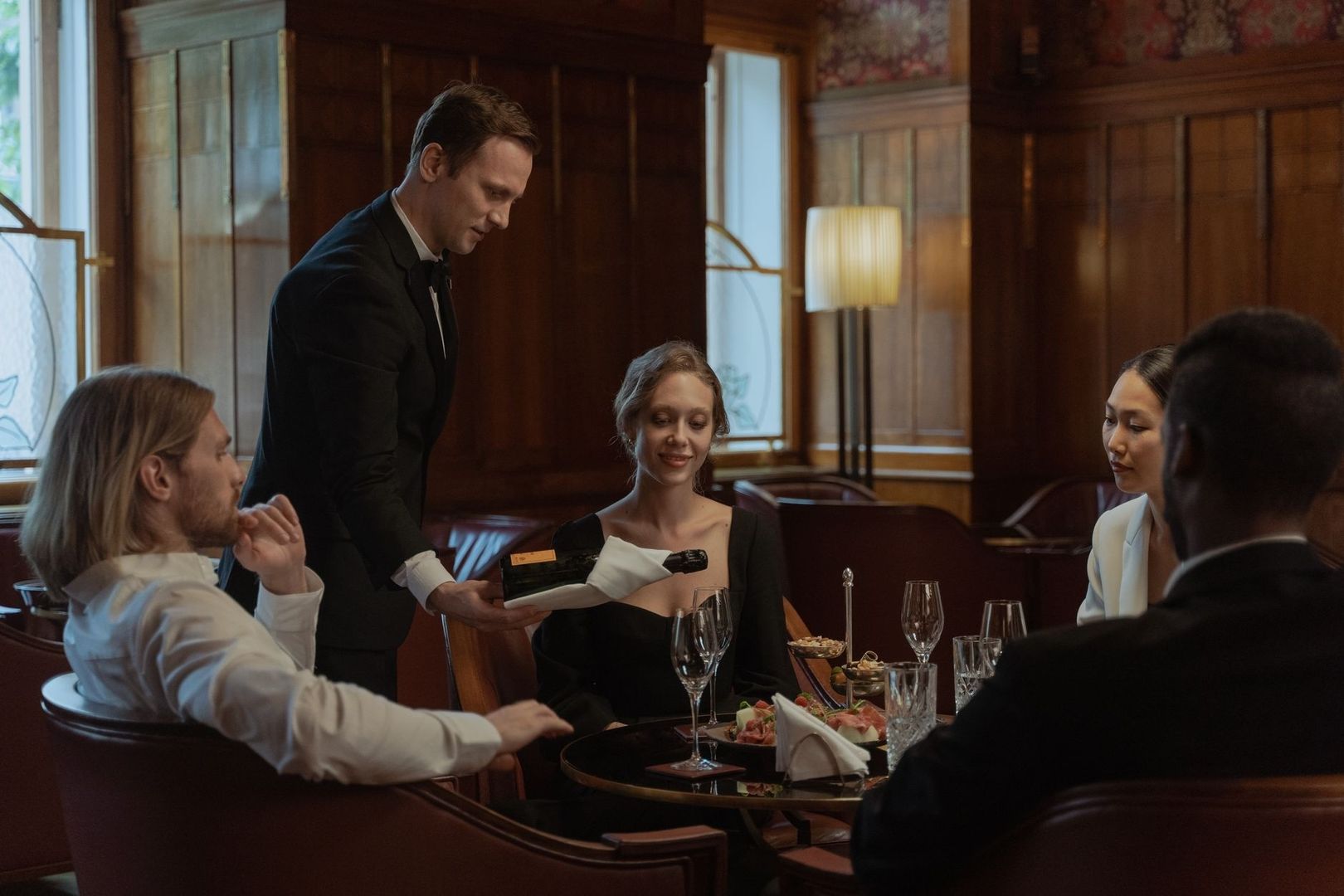
Bottle service is formal enough to protect the guest, the restaurant, and the wine, but it does not require theatrical expertise. When the bottle arrives, the server or sommelier typically presents the label to the person who ordered it. This is the moment to confirm the producer, wine, and vintage. The purpose is identification, not evaluation. If the bottle is not what was selected, speak up before the cork is removed.
The cork may be presented after opening, particularly with older or traditionally served bottles. It can be inspected for obvious leakage or unusual deterioration, but smelling the cork is not a definitive test of wine quality. The more meaningful assessment comes from the small initial pour. Check whether the wine is at a suitable temperature and whether its aroma and flavor seem sound. A red that feels cool, or a white that is slightly warmer than preferred, can often be adjusted without drama.
- Confirm the producer, cuvée, appellation, and vintage against the order.
- Allow the bottle to be opened cleanly, without feeling obliged to comment on the cork.
- Taste the small pour for condition, not personal perfection.
- If the wine seems sound, give a simple approval such as, “That is lovely, thank you.”
- If something seems wrong, describe the problem calmly and ask the sommelier to assess it.
Cork taint is one of the most common concerns. It may smell like damp cardboard, a musty basement, wet newspaper, or mold, and it tends to mute fruit rather than merely make the wine unfamiliar. Other faults can present as sharp vinegar-like acidity, bruised-apple aromas in a still wine, or an unexpectedly flat and lifeless palate. By contrast, a wine that is simply more earthy, acidic, tannic, or restrained than expected is not necessarily flawed.
Use precise but nonjudgmental language: “This seems muted and musty to me,” or, “Could you taste this as well? I am not sure whether the character is intentional.” The sommelier can then evaluate the bottle without defensiveness. If the wine is sound but not to your taste, it is courteous to distinguish preference from fault. The initial taste is not a demand for a replacement because the style differs from expectation; it is a practical quality check that protects the experience for everyone at the table.
Take Command of Your Next Wine Pairing With Ease
The strongest wine conversations begin when diners treat the sommelier as a creative ally. A budget gives the recommendation useful boundaries, plain flavor language reveals the desired style, and the food provides the final architecture. Nothing in that exchange requires a performance of expertise. Clear, honest information is more valuable than perfect terminology.
Point discreetly to a price neighborhood, name a familiar wine as a benchmark, describe the texture or freshness you want, and share the complete order. At the table, confirm the bottle and vintage, taste calmly, and ask for help if the wine seems genuinely flawed. With those habits in place, the wine list becomes less of a challenge and more of an invitation to discover something well suited to the meal. That is the real pleasure of polished dining: confidence without pretense, and a bottle chosen to make the entire evening taste better.